From failed orchards to the Rose CityFrom the 1840s to today
IBefore the roses, peaches1889 to the 1920s
Smith County shipped fruit before it shipped roses. Tyler Today reports that the county harvested 104,283 bushels of peaches in 1889 alone.3The Texas Fruit Palace was built downtown in 1895 to show off the region’s crops, and it closed in 1899.4In July 1905, 100 rail cars of Elberta peaches left Tyler, and the season’s fruit shipments came to 840 cars.5By 1912 Tyler had a minor league baseball team called the Tyler Elbertas, named for the peach.6
420,201peach trees in Smith County in the 1900 census, as cited in Tyler’s 2000 National Register study.7
A millionfruit trees, mainly peach, in the Lindale-Swan vicinity by 1900, says the Handbook of Texas.8
The Rose Garden nomination and Randy Mallory’s 1995 Texas Highways article name San Jose scale, an insect, as the blight that devastated the area’s peach crops; Mallory says many farmers then turned to roses.9The sources do not agree on when.
- The Handbook of Texas, Smith County
- A blight before 1906. Farmers recovered by 1910, helped by W. C. Stallings, hired on November 12, 1906, as the first county agent in the nation to serve a single county.910
- Tyler’s 2000 National Register study
- A blight after 1910, beaten between 1912 and 1918, and a second from 1918 to 1920, after which orchard fruit ceased to be a major crop.11
- The Rose Garden’s National Register nomination
- “Early 1900s,” and also “the 1910s.”9
- Tyler Today, 2021
- San Jose scale had destroyed all the local peach orchards by 1914.12
Farmers who lost their orchards turned to pecans, tomatoes, cotton or roses, and roses proved best suited to the Tyler area.13
IIThe first growersThe 1840s to 1928
Randy Mallory’s 1995 Texas Highways article says veteran nurserymen G. A. McKee and Sam B. Ford independently adapted peach budding, or grafting, to roses; the Rose Garden nomination credits them, with others, with the early development of rose culture in the county.14
- 1840s
A farm near Pine Springs
The Rose Garden’s National Register nomination traces rose growing in Smith County to the 1840s, when Matthew Shamburger came from Tennessee and began experimenting with roses on his farm near Pine Springs.15
- 1870s
The first known commercial roses
The 1975 state historical marker at the Rose Garden says the first known commercial rose production began in the 1870s, when pioneers such as G. A. McKee and Mathew Shamburger (1827–88) sold rose bushes.16
- 1879
A dollar and a half a bush
The Handbook of Texas says the Shamburger family of Pine Springs had sold rose bushes for $1.50 as early as 1879, the year it gives for the first recorded sale of rose plants.17
- 1904
Twenty thousand to the acre
In 1904 B. S. Shamburger began planting roses at 20,000 bushes per acre, a step toward large-scale production.18
- 1917
- 1924
Irrigation
Irrigation came to the Tyler rose fields in 1924, introduced by A. F. Watkins, and the industry grew quickly afterward.21
- 1927
IIIThe nurseries, by nameFrom their catalogs, 1926 to 1959
In 1930, 91 nurseries operated in Smith County, with sales of $291,110.24Tyler’s 2000 National Register study lists the major rose nurseries around 1928 as F.W.H. Rose Nursery, Rosemont Nursery, Southland Nursery, P.C. Moore Nursery Company, Sam P. Ford and Shamburger Rose Nursery, with hundreds of small growers planting one to five acres.25Tyler Today estimates that perhaps eighty families grew roses on small farms in the 1930s, and more than two hundred in the decade after the first festival.26
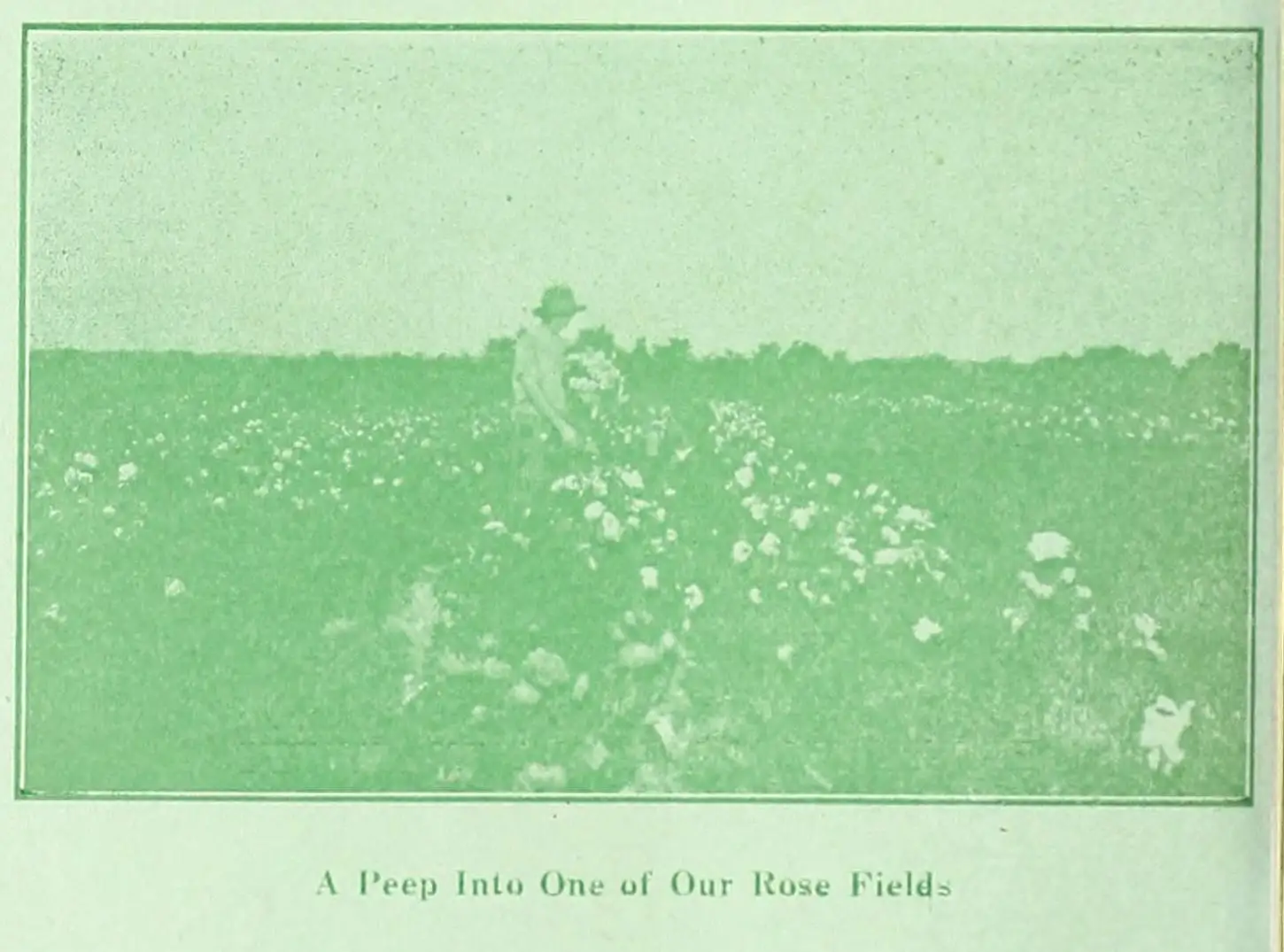
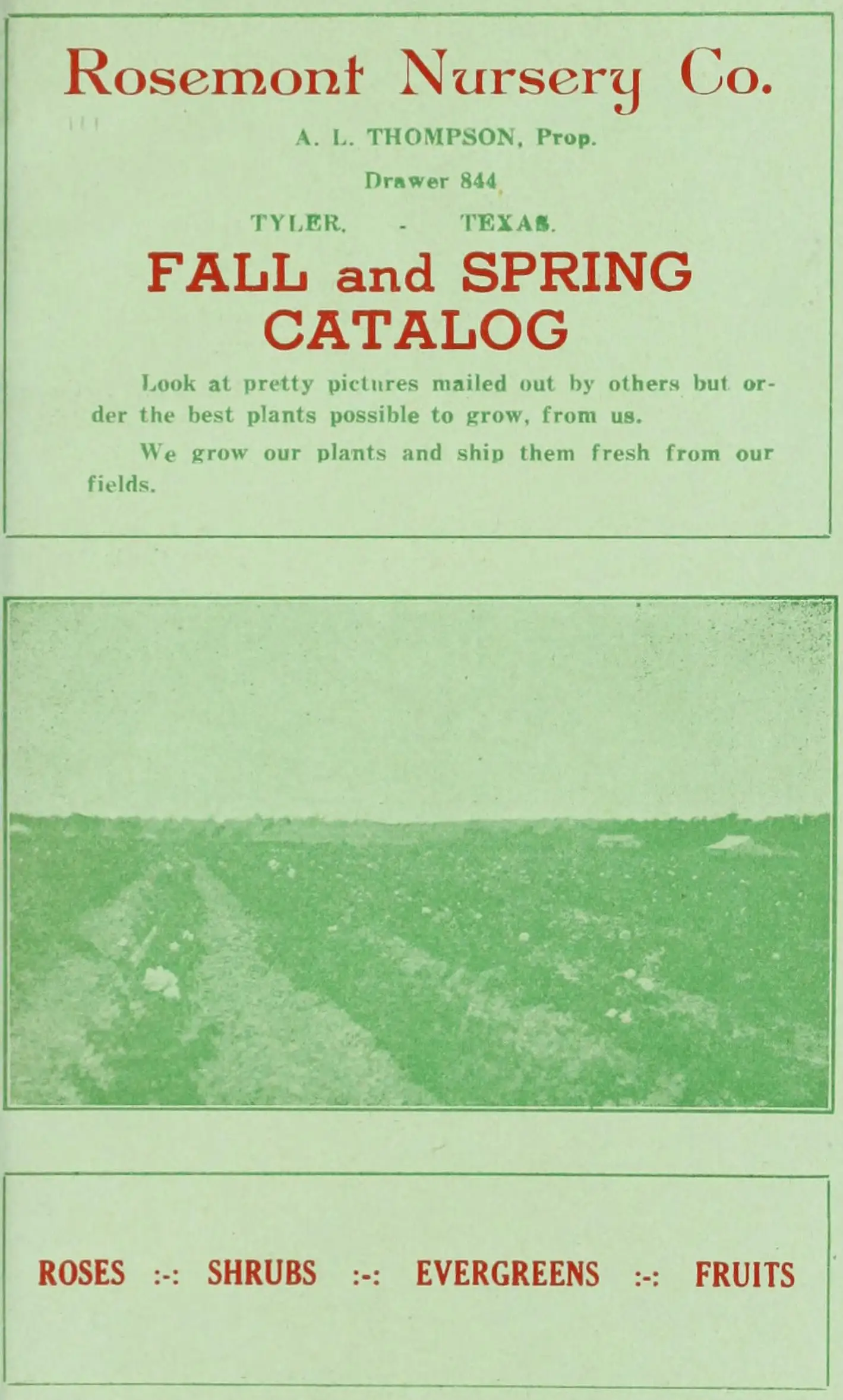
The nurseries sold by mail. Rosemont’s 1928 catalog told customers that small orders should go by parcel post, “safe and much cheaper,” with a 70-pound limit in the nearer zones.27
The trade list
- 1926Rosemont Nursery Co.A. L. Thompson, owner. A spring wholesale list offering to fill car-lot orders in some varieties.28
- 1932Dixie Rose Nursery“Formerly W-H-F Rose Nursery,” in its own words.29
- 1935McClung Bros. Rose NurseryJ. W. and H. H. McClung. Rose-care booklets by 1935; a 28th annual spring sale in 1953.30
- 1935–48Vermay, Rose Hill Farm, Moore, Carl Shamburger, P. O. TateCatalogs kept in the National Agricultural Library’s nursery-catalog collection.31
- 1937Dixie Rose NurseryOwners A. F. Watkins, W. V. Henson and R. W. Fair; “in business for thirty years.”32
- 1940Lang Rose NurseriesA branch of Otto Lang’s Dallas firm: 500,000 two-year field-grown roses, by parcel post or express.33
- 1946Sexton NurseriesRoses and vegetables, the roses sold bare-root by mail order.34
- 1949Cooperative Rose GrowersFifty East Texas growers and a processing plant in Tyler; later Certified Roses.35
- 1950Talisman NurseriesAzaleas by catalog.36
- 1950sChamblee’s Rose NurseryStarted by Roland Chamblee; antique roses from 1990, and the Rose-Arama shop on US 69.37
- 1950sNix RosesStarted by C. L. Nix. Its last crop went into the ground in 2019.38
- 1957Ty-Tex Rose Nurseries“The rose garden of America,” on its catalog.39
- 1957Breedlove NurseriesPromoting ‘Day of Triumph,’ Plant Patent No. 1358, a cross of Peace and Europa.40
- 1959Lone Star Rose NurseryCustom-packaged and bare-root roses, at wholesale.41
IVMade in TylerRoses named, budded and tested here
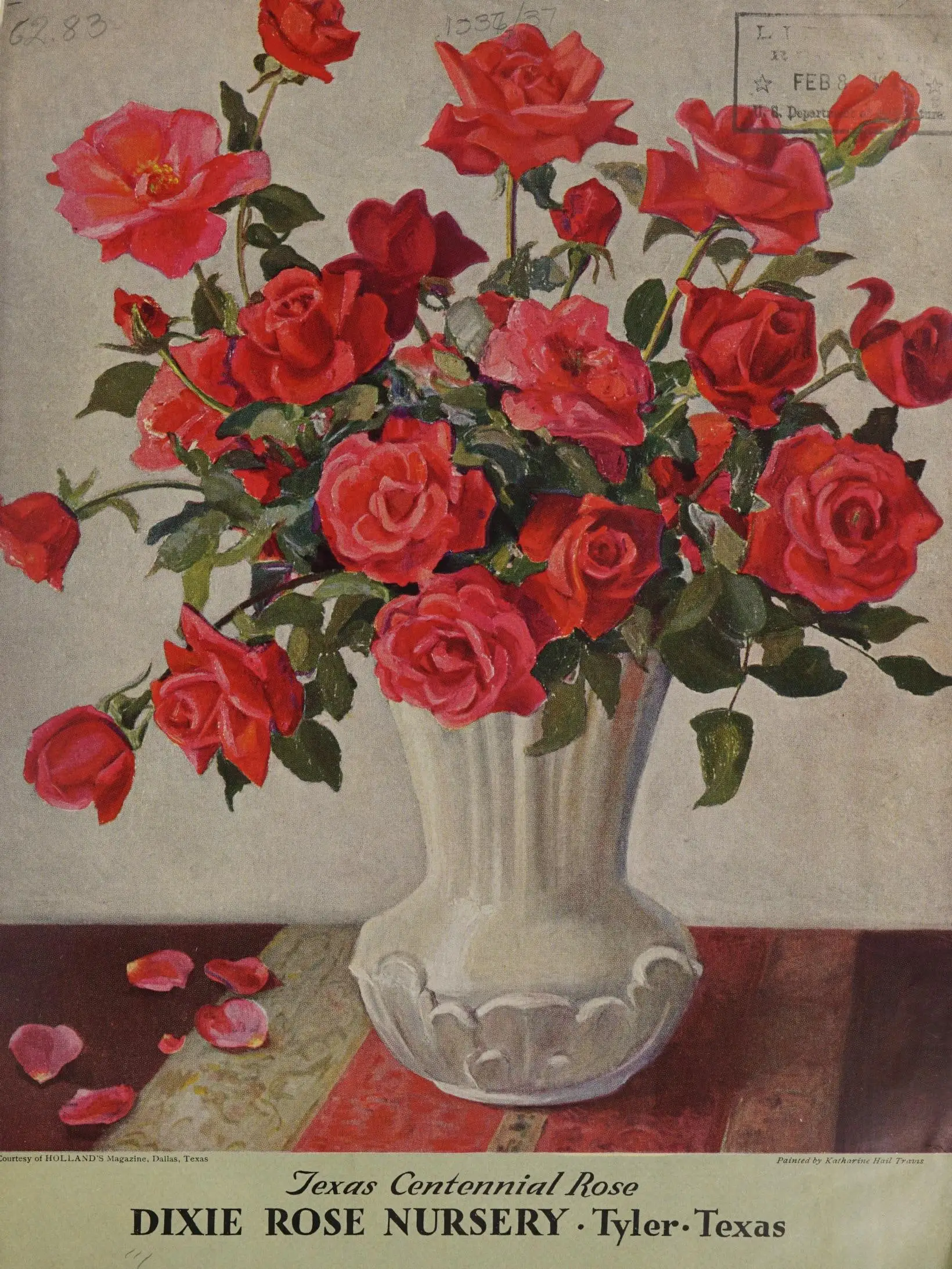
Dixie Rose Nursery of Tyler originated the ‘Texas Centennial’ rose, a sport of ‘President Herbert Hoover’ protected by Plant Patent No. 162 and introduced in 1935.42
Its 1937 catalog offered a dark crimson rose named ‘Queen Gertrude Anne Windsor,’ a Tyler-born sport of Francis Scott Key that it called the sensation of the 1936 Rose Festival. Gertrude Anne Windsor was the 1936 Rose Queen.43
Tyler growers commonly used Brooks-56, a Rosa multiflora understock named for local grower M. L. Brooks, who developed it from one hardy bush he found in his field in 1956.44
Scientific rose research began in the 1930s at the Tyler substation of the Texas Agricultural Experiment Station, by J. C. Ratsek, Dr. E. W. Lyle and others.45Growers organized the Texas Rose Research Foundation in the mid-1940s, and in 1949 it joined national trials of new roses.46Randy Mallory wrote in 1995 that Dr. Eldon W. Lyle, “Tyler’s Rose Doctor,” led the foundation and the development of fungicides against rose diseases, especially black spot.47
VA national tradeCarloads, grades and figures
Around 1928, Tyler’s wholesale rose bushes were two-year-old plants shipped in the fall to eastern markets and held in cold storage there for spring sale.48They went by refrigerated rail car, express, parcel post, motor freight and air freight, mostly to the Northeast.49A Kerrville newspaper reported in 1929 that Tyler had shipped more than 80 carloads of rose plants the year before, plus express shipments.50
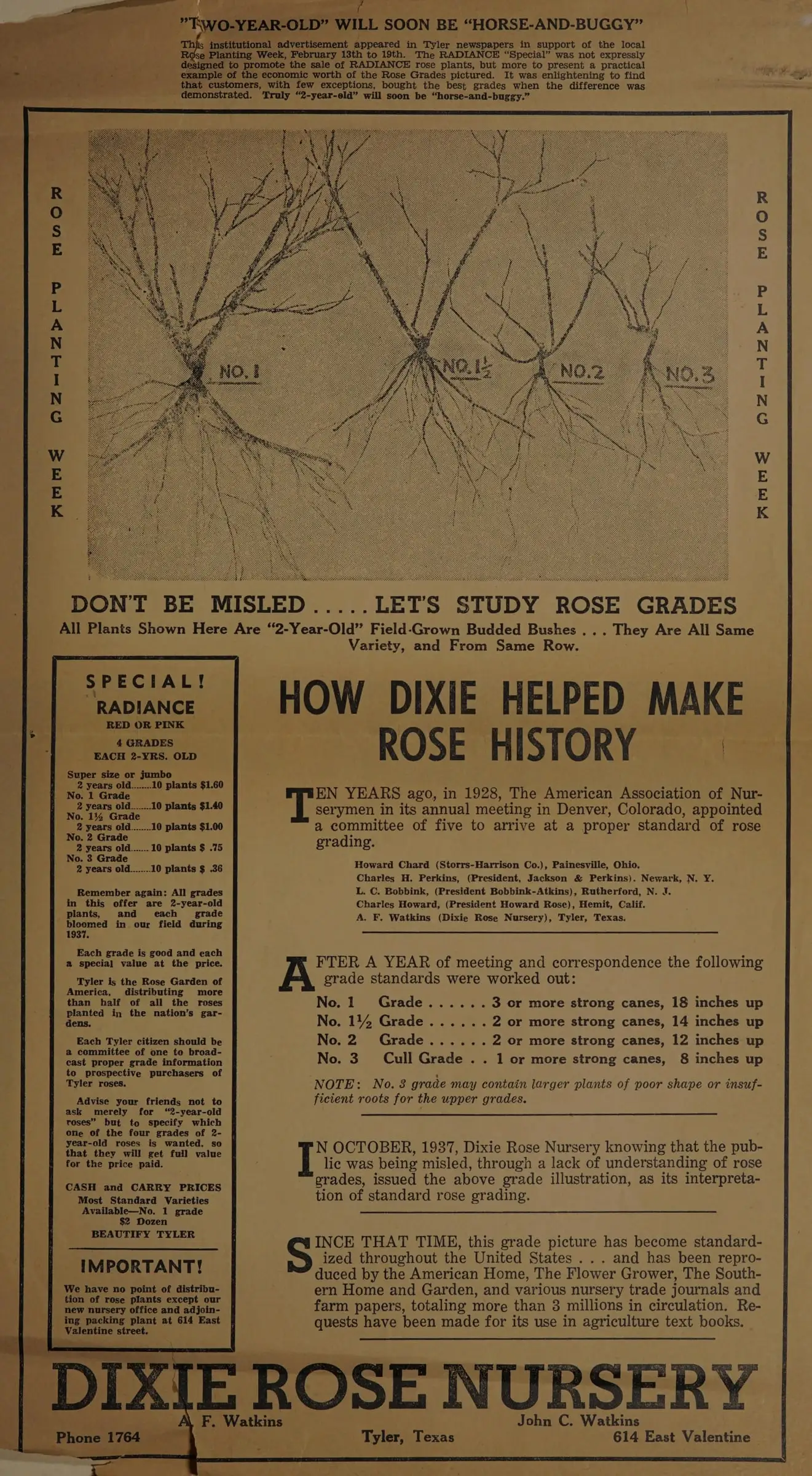
Dixie Rose Nursery’s 1938 advertising sheet says that in 1928 the American Association of Nurserymen appointed a five-member committee to set rose grades, among them Tyler’s A. F. Watkins of Dixie and Charles H. Perkins, president of Jackson & Perkins.51The same sheet claimed that Dixie’s own picture of the grades had become the national standard, reprinted in publications with more than 3 million circulation.52
The trade in figures
| Year | Figure | What it counts |
|---|---|---|
| 1936 | About six million | plants, worth $1 million53 |
| 1945 | 10 to 20 million | plants from about 200 nurserymen with 1,500 employees, worth $3.5 million (Tyler Today gives ten to fifteen million)54 |
| 1945 | 80 percent | of the Texas rose crop, from Smith County55 |
| 1950s | About 250 | rail cars a year from Tyler alone, each of 25,000 plants; around fifteen million plants shipped a year56 |
| 1957 | 2,767 acres | of roses in Smith County, where 225 of the 294 East Texas producers operated57 |
| 1958 | Over 21 million | plants sold58 |
| 1975 | Over 12 million | plants produced in Smith County59 |
By the 1940s
More than half of the nation’s rose bushes were grown within ten miles of Tyler.60
So the Handbook of Texas says. Other sources, in other years, gave other shares. More than half, as a hundred squares
What share of the nation?As each source gave it, in its own year
VIWho did the workIn the fields, the cold rooms and the record
Dixie Rose Nursery’s 1937 catalog described Tyler as the center of the East Texas rose industry, employing hundreds of people.68The Handbook of Texas counts about 200 nurserymen with 1,500 employees in 1945.54
A Tyler rose bush takes two years to grow, so growers kept three crops in the ground at once: one just planted, one budded and one being harvested for cold storage.69
2,000–3,000
Writing in 1995, Randy Mallory said changes in labor supply and market conditions over the previous 20 years had turned Tyler into a national center for processing rose bushes as well as growing them.71
Around 2011 Sexton Nurseries still employed about 120 people in its November-to-May peak season. Its grower and production manager, Lawrence Valdez, had started 25 years earlier in the cold-storage division.72In 2023 he was the chief executive of Certified Roses.73
The Rose Garden’s National Register nomination says that, amid the racial segregation of the era, support for the festival and the future rose garden
“largely came from within and was intended for Tyler’s white society and tourists until desegregation in the 1960s.”74
When the WPA ended five Tyler projects on March 21, 1942, to free 200 men for farm work, they included the rose garden and an African American fair exhibit building at Fair Park.75How Viva La Rosa began, in 2022
VIIThe freezesFrom 1983, three winters running
Starting in 1983, hard freezes below 17 degrees ruined the rose crop three winters running; some multigenerational growers could not afford to start over at the high interest rates of the time.76The Rose Garden lost some 8,000 bushes in the record cold of December 1983.77
Sexton Nurseries stopped growing its own two-year crop in the 1980s, when the weather became too unreliable, and contracted with growers in Arizona and California; by about 2011 virtually all its roses were grown there and shipped to Tyler for processing.78
VIIIProcessing, todayCold rooms, packaging and roses from the West
A rose-processing industry grew up in the 1950s: with cold storage and plastic packaging, Northeast Texas firms processed local plants and roses brought in from Arizona and California, and processing was largely mechanized in the 1960s.79
The Handbook of Texas says that in the early 1990s sixteen million plants a year were processed for mass-market sale, Tyler processors shipped about 2.5 million bare-root plants, and rose production and processing were worth an estimated $50 million a year.80In 1995 Co-Operative Rose Growers, just north of Tyler, ran the largest rose-processing plant in the state, holding dormant bushes at a constant 34 degrees in a one-million-cubic-foot refrigerated storehouse.81
Visit Tyler says that in 2014 two of Tyler’s oldest rose businesses, Certified Roses Inc. and Sexton Nurseries, joined forces, and that David Austin roses are also processed in Tyler.82In 2023 Certified Roses said its Tyler plant processed over four million bare-root garden roses a year, grown mainly in Arizona and California.73In 2021 Tyler Today said the industry was controlled by six or seven families who had moved from growing into processing.83
- 34°
- The cold storehouse at Co-Operative Rose Growers, 1995
- 4 million
- Bare-root roses a year through Certified Roses, 2023
The share of the nation’s processing, as three sources put it
- Congressional Record, 2000Over one-half of the nation’s rose bushes packaged and shipped from the area
- Tyler Today, 202180 to 85 percent of the entire market processed in Smith County
- Tyler Morning Telegraph, 2026Over one-third84
Tyler no longer grows half the nation’s roses; the local industry has since shifted largely from growing roses to processing them.85
IXWhat to call itTitles in print since 1929
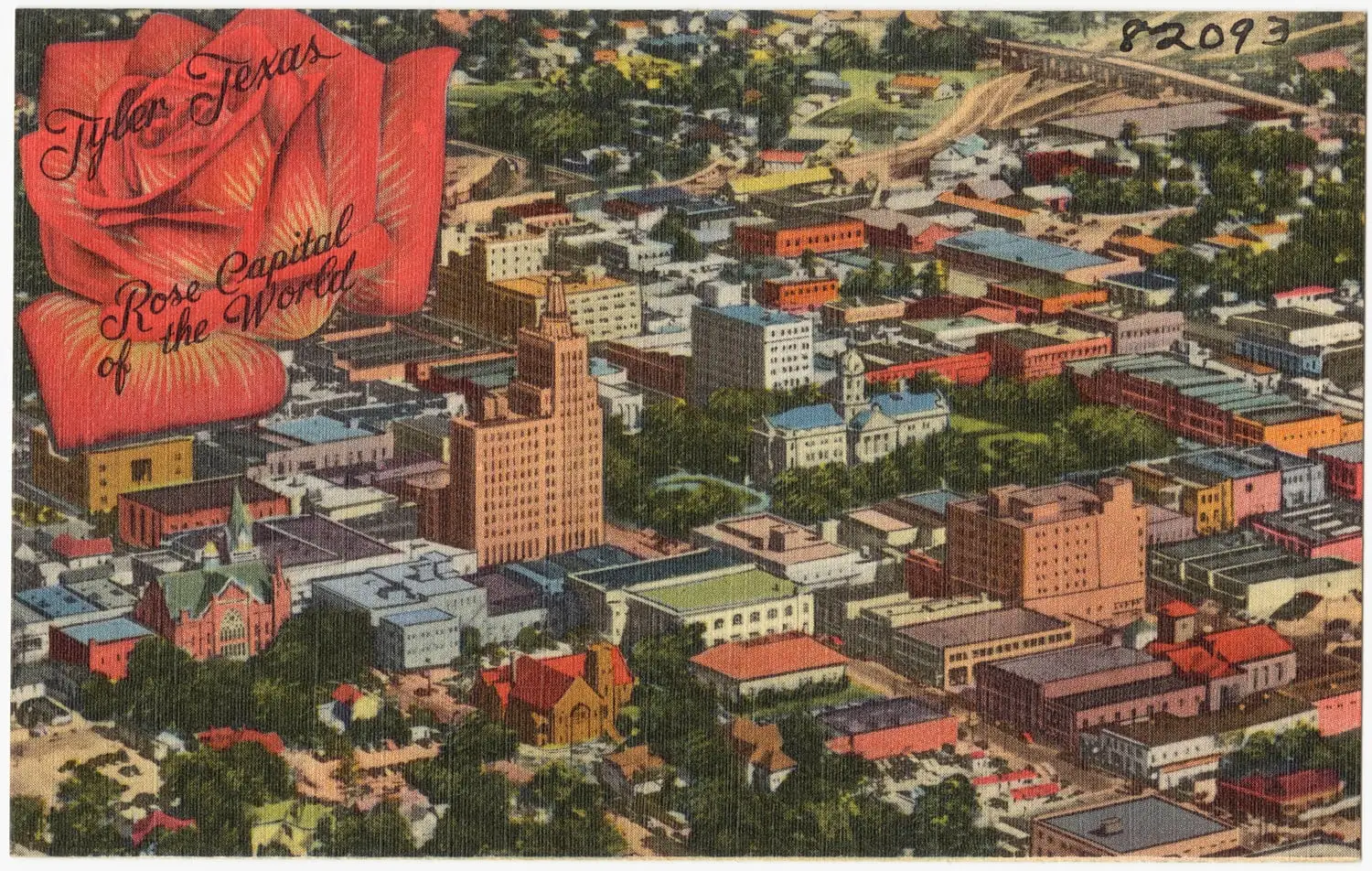
Tyler is often called the Rose Capital of America, and also the Rose City.86The sources do not agree on a title.87
| Title | Used by |
|---|---|
| The rose capital of the world | A Kerrville newspaper, predicting it, 192988 |
| Rose capital of the Southwest | Tyler, at its first festival, 193388 |
| Rose capital of the South | A garden magazine88 |
| Rose capital of the nation | Local newspapers, by 193688 |
| The Rose Garden of America | Dixie Rose Nursery and Ty-Tex Rose Nurseries, 1938 and the 1950s89 |
| Rose Capital of the United States | The city’s website, 201890 |
| Rose Capital of America; Rose Capital of the World | The Handbook of Texas87 |
| Rose Capital of the Nation | The Tyler Morning Telegraph87 |
| The Rose City | Found locally: the Rose City Rivalry football game, the Rose City Fiesta, the Rose City Farmers Market86 |